




Quartz white porcelain tiles for landscaping
Contents |
[edit] Introduction
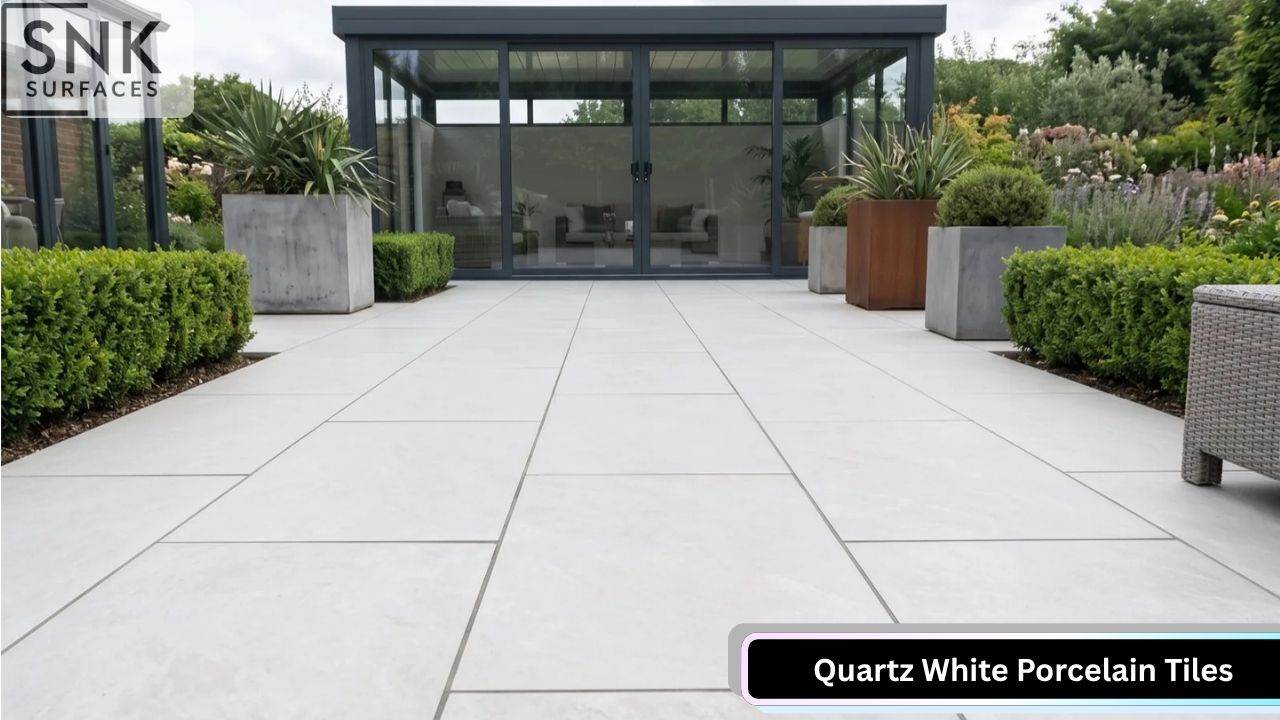
White and ivory porcelain paving, often with a printed marble- or quartzite-effect veining, has become a popular choice for contemporary garden landscaping in the UK. It is used for patios, terraces, paths, courtyards and outdoor dining areas, where it gives a bright, clean appearance that suits modern homes. External porcelain paving is typically 20 mm thick and, when correctly specified and installed, performs well in the UK climate, although its light colour brings particular considerations for maintenance, glare and installation.
[edit] Appearance and design
Light-coloured paving reflects daylight and can make small gardens, courtyards and terraces appear larger and more open. White and ivory tones contrast well with dark outdoor furniture, timber, planting and lawns, and suit pergolas, outdoor kitchens and dining areas. Larger formats reduce the number of visible joints, giving a more continuous surface.
Because the pattern is applied digitally during manufacture, porcelain gives a more consistent appearance than natural stone, which helps achieve a uniform finish across larger areas. Manufacturers usually produce several different faces for each design to avoid obvious repetition, and tiles should be mixed during laying. Very light surfaces can, however, produce glare in strong sunlight, and they may offer poor visual contrast at changes of level, so step nosings and edges may need a contrasting finish to help people with impaired vision.
[edit] Performance in the UK climate
UK gardens are exposed to frequent rainfall, cold winters and repeated freeze-thaw cycles. Porcelain is a dense, fully vitrified ceramic with water absorption of 0.5% or less (group BIa under BS EN 14411), so very little water can enter the tile. This makes it highly resistant to frost damage, which is assessed by the frost resistance test in BS EN ISO 10545-12. Porcelain is also colourfast in sunlight, resistant to most stains and chemicals, and does not normally require sealing.
Frost resistance of the tile alone does not guarantee a durable installation. If water collects in the bedding or sub-base beneath poorly laid slabs, freeze-thaw action can cause bedding failure, loose tiles and cracked joints. Porcelain is impermeable, so the paving must be laid to falls that direct surface water to a drain, soakaway or planted area. In England, planning permission is normally needed to lay more than 5 m² of impermeable paving in a front garden unless the water is directed to a permeable or porous area within the property.
[edit] Slip resistance
Outdoor porcelain is produced with a textured surface to improve grip, and white porcelain paving is often sold with an R11 rating. This is based on the German ramp test (DIN 51130), which uses an oil contaminant and safety footwear, so it does not directly represent wet external conditions. In the UK, the Health and Safety Executive recommends the pendulum test (now covered by BS EN 16165), in which a pendulum test value (PTV) of 36 or above in wet conditions indicates low slip potential. Manufacturer test documentation should be checked rather than relying on descriptions such as anti-slip. For pool surrounds and other barefoot wet areas, a barefoot classification (DIN 51097, class B or C) should be confirmed.
An R11 rating alone does not guarantee safety in every situation. Slip resistance in use also depends on contamination, wear and maintenance, so paving should be kept free of algae, mud and fallen leaves, with particular attention to steps, ramps and sloping surfaces.
[edit] Sizes
White porcelain paving is commonly available in 20 mm thickness in the following formats:
Format (mm) Typical applications
600 x 600
Small patios, courtyards and paths
600 x 900
800 x 800
Larger outdoor spaces and commercial projects
The 600 x 900 mm format is a versatile choice for many patios, while larger formats give a more continuous appearance and smaller formats offer greater flexibility in compact or irregular spaces. The choice should also take account of cutting, joint layout, falls and drainage.
[edit] Installation
Porcelain paving should be laid on a stable, well-compacted sub-base with suitable falls to shed rainwater. For rigid installations, a full mortar bed should be used, and because porcelain is so dense a compatible bonding slurry or primer must be applied to the back of each tile to achieve adhesion. Jointing should follow the manufacturer's recommendations, using a cementitious or resin-based compound suitable for external use, and movement joints should be provided at perimeters, at changes of substrate and at intervals across large areas. Levels and drainage should be checked before the installation is completed.
White paving is particularly susceptible to staining during installation. Mortar, jointing compound and cement residues should be cleaned off immediately, since they are difficult to remove once cured, and dark jointing compounds can stain light tiles. Efflorescence from the mortar bed may also appear as white deposits in joints or on darker adjacent surfaces. For commercial landscaping, contractors should confirm that the product and installation method meet the project's technical requirements.
[edit] Maintenance
Porcelain is easier to maintain than most porous natural stones because its low porosity prevents dirt and common household stains from penetrating the surface, which is useful in outdoor dining areas. White paving will, however, show mud, bird droppings, leaf marks and algae more readily than darker colours. Surfaces should be swept regularly, washed with clean water and a mild detergent, and kept free of organic debris, algae and moss. Harsh chemicals should be avoided unless approved by the manufacturer, and some textured anti-slip surfaces may need scrubbing with a stiff brush to remove ingrained dirt.
[edit] Comparison with natural stone
The choice between porcelain and natural stone depends on design preferences and maintenance requirements. Porcelain offers a consistent stone-effect appearance, very low water absorption, high stain resistance and low routine maintenance, making it well suited to bright, contemporary designs. Natural stone offers genuine variation in colour, texture and character and can be more easily reworked or reused, but many stones are more porous and may need sealing and more regular care, depending on their type and finish.
[edit] Related articles on Designing Buildings
Featured articles
Check out some of the best features and news from Designing Buildings as well as key stories from around the web.

More of England’s ‘hidden heroes’ will be celebrated.

CIAT calls for retrofit to be a priority.

Version 6 is now available, along with guidance for ECA members.

Post-War Homes: mid-century British architecture. Book review.

CIAT reflects on the party conferences.

CIOB announce the winners of the Art of Building photography competition.

National Scheme of Delegation introduced.

The cost of employing people remains a concern.
Code of Practice for Electrical Energy Storage Systems.

ECA calls on members to comment on draft 4th edition.

Bringing together expertise and creating cultural benefits.

CIOB celebrates positive Ofsted report.

The Building Safety Regulator announces a call for evidence.